Surprising statistic: a well-configured login and session model can cut the practical risk of account compromise by a far larger margin than any single cold-storage policy — because most losses trace back to session-level failures, not raw custody design. For US traders on OKX that is an uncomfortable but useful truth. The exchange combines institutional-grade controls (cold storage, proof-of-reserves) with consumer conveniences (biometric mobile logins, browser extension). That blend creates powerful capabilities for trading — especially futures and derivatives — but it also creates interaction points where simple mistakes or weak habits magnify market risk.
This commentary walks through how OKX’s login, account protection, and product design mesh with its futures offering. I’ll unpack the underlying mechanisms that determine safety and leverage risk, correct two common misconceptions about “security vs usability,” and offer a compact decision framework traders can reuse when choosing login settings, device posture, and leverage levels.
How OKX Login Works: mechanisms that matter to traders
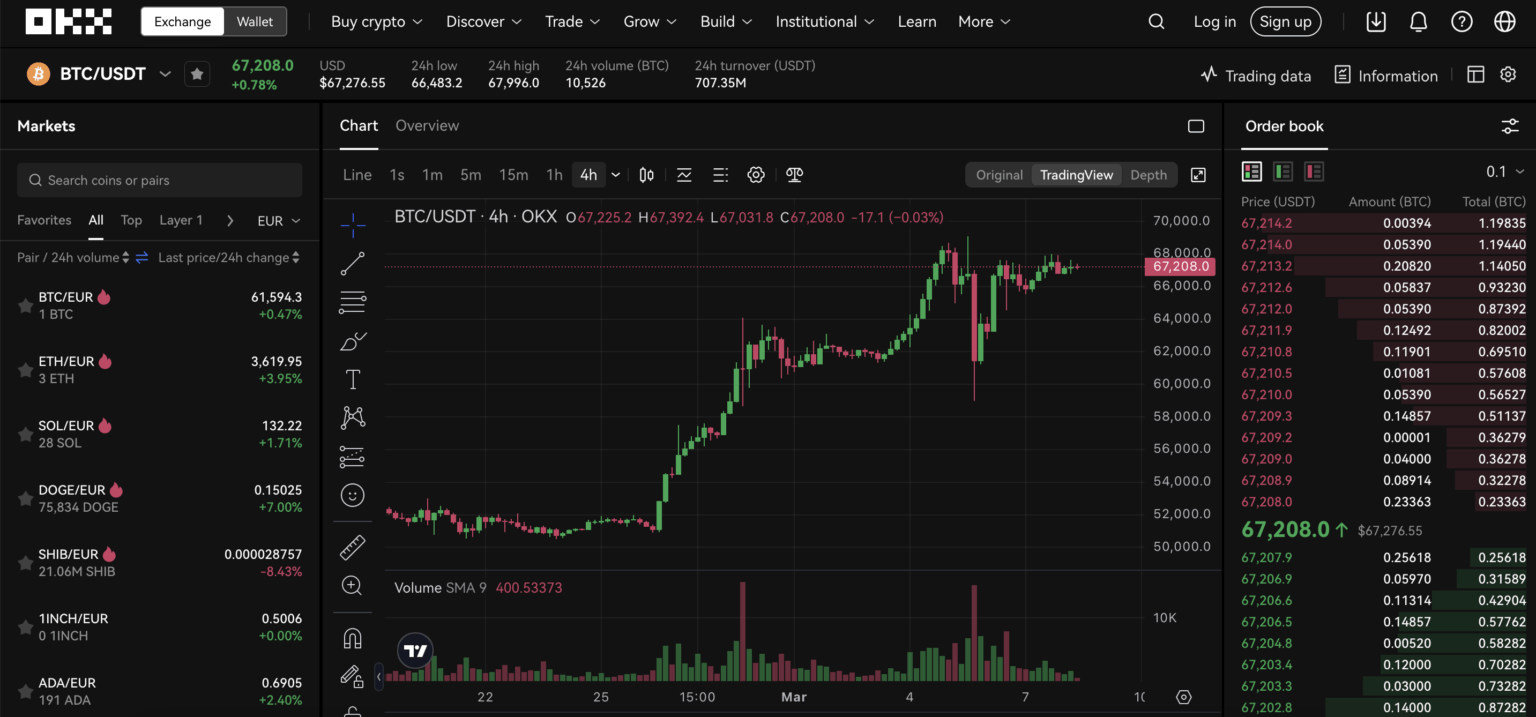
At the technical level, OKX provides multiple access vectors: a web platform with TradingView charting, mobile apps with biometric login, and a browser extension that connects to Web3. Mechanistically, secure login relies on three interacting layers: identity verification (KYC), session authentication (password + 2FA or biometrics), and platform-side threat detection (AI-driven anomaly flags). KYC ties an account to a verified identity and is mandatory; 2FA or biometrics is mandatory for sensitive actions; and AI-based systems monitor for suspicious logins so the platform can step in or force re-authentication.
Why that matters: futures and margin positions are not only high-leverage financial instruments — they are stateful. Open positions, collateral adjustments, and cross-margin settings persist across sessions. A stolen session can therefore liquidate positions or trigger cascading margin calls in seconds. Good login hygiene is not bookkeeping; it is a core part of your risk control system.
OKX Futures: the leverage mechanism and where it breaks
OKX offers a full derivatives stack: perpetual swaps, quarterly futures, and options, with leverage up to 125x on select instruments. Mechanically, leverage multiplies exposure by borrowing settled or cross-collateralized funds to enlarge notional position size. The platform offers isolated and cross-margin modes — isolated limits risk to a single position, cross-margin shares collateral across positions. Each choice reconfigures the loss surface: isolated confines losses but can lead to premature liquidation; cross-margin smooths intraportfolio volatility but risks wiping out the entire margin pool.
Common misconception corrected: high leverage does not inherently create faster losses; it creates a steeper relationship between price movement and margin. Execution environment, slippage, and liquidity matter more than nominal leverage when markets gap. In low-liquidity pairs (and note that OKX delisted some low-volume tokens this month as part of routine pruning), slippage and wide bid-ask spreads can make stop orders ineffective and force larger-than-expected losses.
Trade-offs: usability, custody, and speed
There are three practical trade-offs for US-based traders on OKX. First, convenience versus control: mobile biometric login and browser extensions reduce friction but increase the attack surface if the device is compromised. Second, centralization versus self-custody: OKX stores over 95% of customer assets in multi-signature cold wallets and supports a non-custodial Web3 wallet; custody choice determines who bears which risks. Third, leverage convenience versus liquidation risk: easy one-click leverage is tempting but puts a premium on monitoring and execution latency.
A balanced heuristic: treat every active derivatives account like a short-duration crypto fund. Use the most secure login posture (hardware-backed 2FA, isolated margin for speculative positions), limit leverage proportionally to your monitoring ability, and keep strategic reserves in cold or self-custodial wallets disconnected from day-trading sessions.
Where OKX’s design helps — and where it doesn’t
Strengths: built-in proof-of-reserves provides an on-chain transparency signal that the exchange attests to backing user deposits; multi-layer login (2FA, biometrics) and AI threat detection shrink the window for automated attacks; broad instrument coverage and TradingView charting support sophisticated strategy execution. The cross-platform architecture — web, mobile, extension — also makes it feasible to maintain separate devices for custody and active trading, a practical best practice.
Limitations and residual risks: PoR attests to aggregate backing but does not eliminate counterparty, settlement, or operational risk. KYC is necessary for regulatory compliance in the US, but it can also make an account an attractive target because it usually links to recoverable fiat rails. Browser extensions that ease Web3 interactions can leak metadata or be phished. Finally, delistings of spot pairs (a recent example this month) are normal housekeeping, but they can compress liquidity for certain tokens and create execution risk for margin users holding delisted assets.
Decision framework: five quick checks before you open or change a futures position
1) Authentication posture: use hardware-backed or app-based 2FA; reserve SMS only as a fallback. 2) Session hygiene: enable device biometrics only on trusted devices and avoid browser extensions on machines you use for other risky activity. 3) Margin mode: default to isolated margin for single-position experiments; use cross-margin only when you maintain diversified offsetting positions. 4) Leverage cap: tie max leverage to your monitoring frequency — higher leverage requires active supervision or automated risk limits. 5) Liquidity check: before entering a position, inspect order book depth and recent spreads; if the book is shallow, reduce size or avoid market orders.
For practical instructions on logging into OKX (device choices, 2FA setup, and recovery steps), see the entry guide linked here. Treat that as a companion operational checklist rather than a substitute for continuous vigilance.
Near-term signals to watch
Three conditional scenarios matter in the coming months. If macro volatility increases, expect greater funding-rate swings in perpetuals and more frequent margin calls — that amplifies the importance of session security. If regulatory scrutiny in the US tightens around derivatives trading, expect changes to product availability, KYC stringency, or acceptable leverage; prepare to adjust position sizing and liquidity assumptions. Finally, continued pruning of low-volume spot pairs (the exchange announced routine delistings this month) signals that exotic alt liquidity can vanish quickly; traders should avoid assuming perpetual liquidity for low-cap assets.
FAQ
Q: Is OKX safe for US traders who want to trade futures?
A: “Safe” is relative. OKX offers robust institutional controls — cold storage, PoR, AI threat detection, and mandatory 2FA — which reduce platform-level risk. However, trading futures is inherently risky due to leverage and liquidity dynamics. Your personal safety depends on how you configure login, custody, and margin modes, and on operational practices such as device hygiene and position sizing.
Q: Should I use cross-margin or isolated margin on OKX?
A: Use isolated margin for single speculative trades or when testing strategies. Use cross-margin when you have offsetting positions across contracts and want to optimize capital efficiency. Remember that cross-margin increases the risk that a single bad leg can consume collateral across your entire derivatives exposure.
Q: How does OKX’s Proof of Reserves affect my decision to keep assets on the exchange?
A: PoR improves transparency about aggregate backing, but it is not insurance against operational failure or regulatory seizure. Treat PoR as one positive signal among others (insurance, incident history, custody architecture) and maintain a split posture: day-trade with a portion on-exchange and retain long-term holdings offline or in self-custody.
Q: What login configurations materially reduce risk?
A: The most effective changes are using app-based or hardware 2FA, enabling device biometrics only on secure personal devices, and avoiding reuse of passwords across sensitive accounts. Combine that with periodic review of connected apps and OAuth permissions and frequent firmware updates for hardware wallets and devices.
Closing note: OKX stitches together powerful derivatives tools and modern login conveniences. That combination can be a competitive advantage for US traders who understand the mechanics behind session risks, leverage, and liquidity. The tactical choices you make at login time — device discipline, 2FA method, and custody split — will often determine how well you survive a fast market move, not the exchange’s cold wallet balance or a headline about proof-of-reserves. Treat security and position sizing as two sides of the same risk-management coin.